
The Benefits of In-Die Tapping for Parts Requiring Threaded Holes
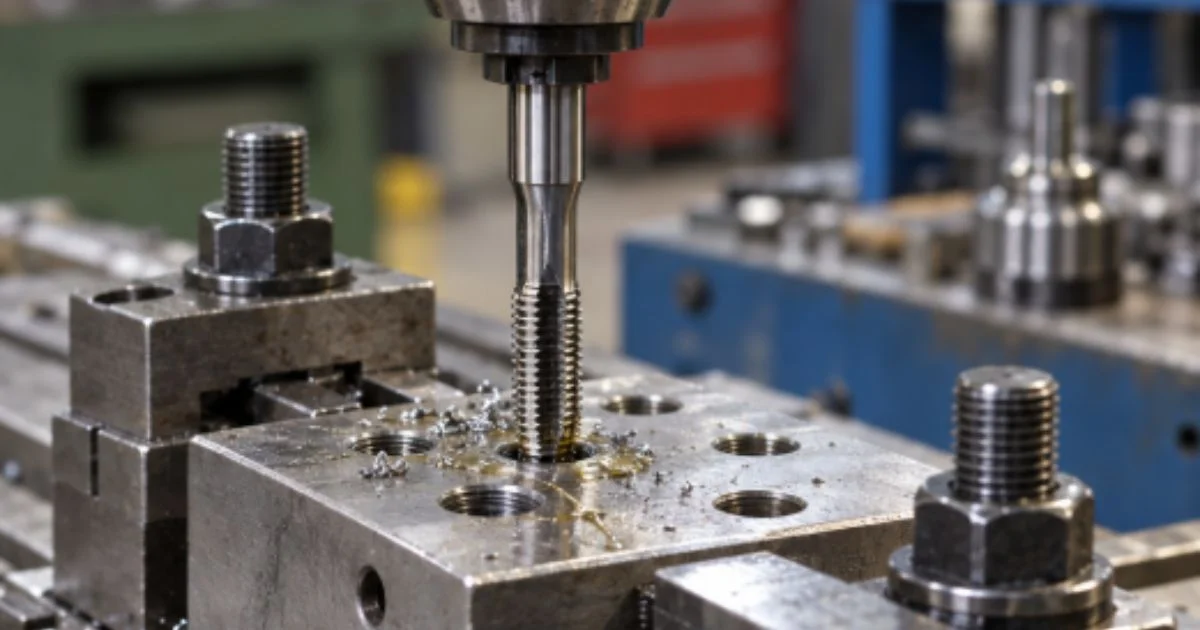
When a custom metal stamped part requires a threaded hole, there's a lot more to consider than simply adding threads to the component itself; how you actually make the hole has a significant impact on production speed, labour requirements, ongoing consistency, and material handling and the overall cost of the finishing part.
In many cases, a stamped metal component requires a threaded hole that may go through the stamping process first, followed by a separate tapping operation. This can be especially useful in several applications, but it can also create additional production steps:
Parts need to be collected
Parts need to be moved
Parts need to be staged
Parts need to be fed through another machine
Parts need to be prepared for the next stage of manufacturing
Enhancing efficiency doesn't require cutting corners – it requires the right processes to get the job done. Manufacturers that need high-volume production can greatly benefit from in-die tapping to streamline their processes.
Today, Globe Stamping will walk you through the benefits of in-die tapping for custom metal parts that require threaded holes, how it can save you time and money, and more.
What is In-Die Tapping and Why is it So Important?
In-die tapping is a process that adds an automatic thread-tapping mechanism into the overall metal stamping process. Other than providing a reliable final product, it also adds a great deal of efficiency to the custom metal stamping process. This allows manufacturers to streamline even detailed and relatively complex parts that require threaded holes by combining the stamping and tapping into one continuous operation.
In-Die Tapping Creates Strong, Consistent Threads
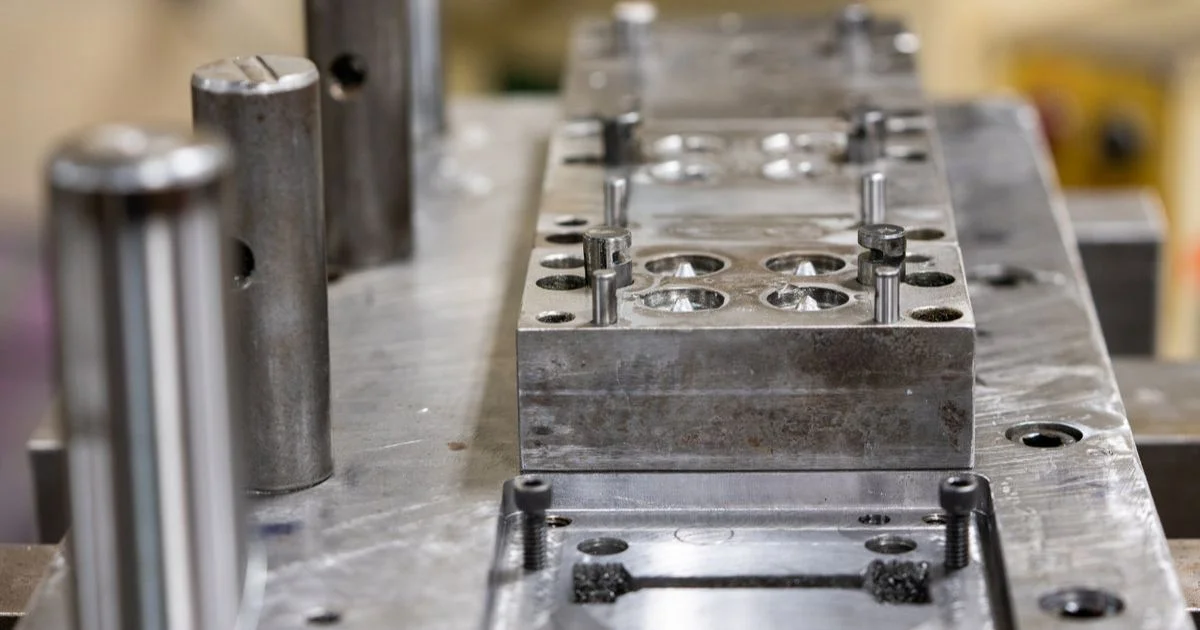
When you integrate mechanical or servo-driven tapping units into a progressive die, you allow internal threading, forming, and cutting to occur inside the stamping press, eliminating offline secondary operations.
But what exactly does this mean?
The process refers to placing a small, motor-controlled thread-forming mechanism inside the stamping die, allowing the part to be threaded while it's still being stamped. This creates greater potential efficiency without having to create additional processes.
Let's break it down a little further:
A progressive die is a stamping tool used for multiple stations; a strip of metal moves through the die while different stations perform several operations, ranging from punching to forming to cutting. The part remains connected to the strip until the appropriate point in the process.
As the metal strip moves through the die, the tapping head works in sync with the press to form the threads in the extruded hole before the finished part is separated from the strip.
Rather than having to cut material away to create the threads, roll tapping (also known as form tapping) pushes and reshapes the metal around the hole in order to form the thread. This chip-free process maintains the material's overall structure, contributing to stronger and more reliable threads, while also reducing the potential risk of loose metal chips building up inside the die and negatively impacting the tooling.
This is why in-die tapping is considered the most reliable means of achieving higher production volumes for custom metal parts; it eliminates potential problems that could occur and slow down the line.
Streamlining Operations Can Help Cut Labour Bottlenecks
A progressive die produces the stamped component, and the completed parts are collected in bins. Those bins then have to be transported to a secondary tapping station. An operator feeds the parts into a standalone tapping machine, removes them, and prepares them for the next stage.
While none of this seems particularly complicated, when several parts are involved, every additional step can add to time and labour costs. In-die tapping combines these operations. Rather than producing a part first and tapping it later, the thread is formed as part of the stamping sequence, making the process more efficient.
This reduces the need for additional part handling between operations. There isn't any need to move large quantities of unfinished components to a separate tapping area, and there is no need for a separate manual feeding operation for the tapped component.
The savings businesses can realize from reduced labour extend far beyond eliminating an operator from a tapping machine.
Instead of having employees regularly move bins, load parts, or monitor a repetitive (secondary) process, they can be redirected towards higher-value activities such as machine setup, quality inspection, material handling, or other necessary production requirements.
For manufacturers producing copious quantities of the same component, that difference can become significant.
Fewer Delays, Less Work-in-Progress
Unfortunately, secondary tapping stations can create a "stop-and-go" bottleneck, delaying manufacturing and creating problems. By eliminating that secondary station, you can reduce what we call "Work-in-Progress" Piles (WIP). This means that parts don't end up sitting in a massive queue waiting for completion at a secondary station when it becomes available. According to Statistics Canada, "Work in Process" (WIP) manufacturing inventory (recorded as "goods in process"), reached a historical high of $36.90 billion CAD, marking a 14.09% increase as of 2020, year over year.
By bringing tapping into the stamping process, manufacturers can eliminate the need for a separate tapping station, freeing up valuable floor space while keeping parts from piling up between production stages.
By accelerating the production cycle through in-die tapping, you can move from point A to point B and get custom metal parts ready to ship or plate in a continuous flow.
In-Die Tapping Provides Consistent Quality Control and Accuracy
When you work with Globe Stamping, maintaining consistent quality is critical for every part of metal stamping. This is especially vital when threaded holes for custom metal parts are needed. In-die tapping supports custom part consistency by performing the threading operation within the stamping die itself, where rigid, fixed alignment ensures that each hole is positioned accurately and threaded to each unique specification on every press stroke.
This controlled process reduces the potential variation that occurs when parts are moved to secondary operations, thereby creating reliable, repeatable results across even larger production lines. Modern in-die tapping systems also incorporate die-protection sensors that immediately stop the press if a tap breaks or a potential safety concern is detected, preventing damage to tooling, minimizing scrap, and ensuring quality standards are maintained throughout the entire production process.
While in-die tapping requires an upfront investment in engineering, tooling, and integration, the return on investment can be significant for medium- to high-volume production programs. Eliminating secondary tapping operations reduces labour requirements, material handling, floor space usage, and production bottlenecks, allowing parts to move more efficiently through the manufacturing process.
Faster throughput, fewer touchpoints, and reduced scrap rates can quickly offset initial costs, particularly for components produced in copious quantities over extended periods. At Globe Stamping, evaluating factors such as annual production volumes, part complexity, and long-term manufacturing goals helps determine when in-die tapping can provide the greatest value, delivering both cost savings and dependable quality for customers.
Calculating the ROI of In-Die Tapping
The upfront investment of in-die tapping can be intimidating in the beginning, but it's one of the most important considerations when deciding whether in-die tapping is right for you and your business. An integrated tapping system can require additional engineering, tooling design and equipment compared with a basic stamping die. That means the decision should not simply be based on whether a threaded hole can technically be produced inside the die. The question is whether the production savings justify the additional investment.
For a low-volume component that only requires a small number of parts, the additional tooling investment may not make sense. A secondary tapping operation could be more practical. However, as production volume increases, the economics can change. The more parts produced, the more opportunities there are to save labour and handling time with every production cycle.
A useful ROI analysis should consider several factors:
Annual production volume: How many parts will be produced over the life of the tooling?
Direct labour: How much time is currently spent on loading, unloading, moving, and tapping parts?
Cycle time: How quickly can the integrated process produce finished components?
Material handling: How much time is spent moving WIP between stamping and secondary tapping?
Floor space: Is a separate tapping machine and staging area required?
Quality costs: Could eliminating an additional handling operation reduce positioning errors or scrap?
Tooling investment: What additional engineering and equipment are required to integrate tapping?
Part requirements: Are the material and geometry suitable for form tapping and in-die production?
There is no single production-volume threshold that applies to every project. The break-even point depends on the part, material, thread requirements, production rate, labour costs, tooling complexity, and expected production life.
For that reason, an experienced stamping manufacturer should look at the entire production process rather than simply comparing the purchase price of a tapping unit with the cost of a standalone machine.